Imagine standing beneath the Egyptian sky on the afternoon of August 2, 2027, as the sunlight begins to fade, shadows sharpen, and the temperature drops. The Moon moves across the Sun until daylight disappears for several extraordinary minutes. This total solar eclipse will cross parts of Egypt, giving travelers the rare opportunity to experience totality among some of the country’s most remarkable landscapes and ancient sites.
The eclipse will not look the same everywhere in Egypt. Luxor, Siwa Oasis, and Asyut are among the locations within the path of totality, while Cairo will experience a partial eclipse. Totality is expected to last about 6 minutes and 22 seconds in Luxor and 5 minutes and 31 seconds in Siwa Oasis. This guide explains how solar eclipses happen, where to experience the 2027 eclipse, how to watch it safely, what totality looks and feels like, how to photograph it, and what it reveals about Egypt’s ancient relationship with the sky.
For travelers planning an eclipse journey, choosing the right viewing location is only the beginning. With a well planned itinerary, you can combine the eclipse with Luxor’s temples and Valley of the Kings, a Nile journey, or the landscapes of the Western Desert. Tripidays’ Egypt solar eclipse tours are designed to bring the eclipse experience together with the country’s historic and cultural highlights, while travelers looking for a more personalized itinerary can also build a custom Egypt tour around the event.
What Is a Solar Eclipse?
A solar eclipse happens when the Moon passes between Earth and the Sun and blocks some or all of the Sun’s light from reaching a particular area on Earth.
The Moon’s shadow does not cover the entire planet. Instead, different parts of Earth experience different views of the same eclipse. This is why an eclipse can be total in one location and only partial a few hundred kilometers away.
For travelers, this is the most important point: your exact viewing location determines the type and duration of the eclipse you experience.
What Is the Difference Between Eclipse Types?
There are four main types of solar eclipse:
- Total solar eclipse: The Moon completely covers the visible disk of the Sun for observers within the path of totality.
- Partial solar eclipse: The Moon covers only part of the Sun.
- Annular solar eclipse: The Moon appears slightly smaller than the Sun, leaving a bright ring around it.
- Hybrid solar eclipse: The eclipse can appear total or annular depending on the observer’s location.
The August 2, 2027 event is a total solar eclipse, but totality will only be visible from specific locations along its path. Egypt is one of the countries crossed by that path.
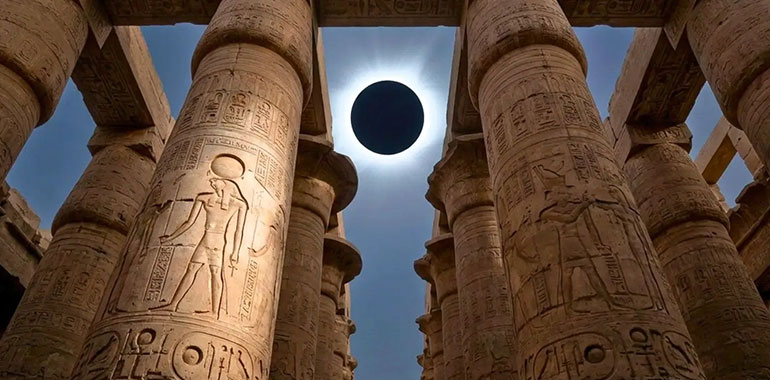
Why Is Egypt a Special Place to Experience a Solar Eclipse?
Egypt offers something that few eclipse destinations can match: the opportunity to experience a major astronomical event alongside thousands of years of history.
The eclipse gives you a reason to travel. Egypt gives you thousands of reasons to stay.
A trip can combine eclipse viewing with the temples of Luxor, the Valley of the Kings, a Nile cruise, Cairo’s historic attractions, or the desert landscapes around Siwa Oasis. This makes the event different from a short astronomy-focused trip where the eclipse is the only purpose of the journey.
Egypt and the Ancient Observation of the Sky
Ancient Egyptians closely observed the Sun, Moon, stars, and seasonal cycles. Astronomy played an important role in calendars, timekeeping, religious traditions, and the orientation of temples.
However, ancient Egyptian observations should not be confused with modern eclipse science. Modern predictions depend on precise astronomical calculations and measurements that were not available in antiquity.
What makes the connection interesting is the broader cultural relationship with the sky. During an eclipse trip, places such as ancient temples and the Dendera complex provide a way to explore how the Egyptians incorporated celestial observations into their worldview.
When Is the Next Solar Eclipse in Egypt?
The major upcoming event for travelers is the total solar eclipse on August 2, 2027.
NASA lists the August 2, 2027 eclipse as a total solar eclipse visible across parts of southern Europe, North Africa, the Middle East, and other regions. Within Egypt, the path of totality crosses areas including Luxor, Asyut, and Siwa Oasis.
The August 2, 2027 Total Solar Eclipse
In Egypt, the eclipse begins with a partial phase before totality and ends with another partial phase.
The exact timing changes according to location. For example, current calculations give these approximate maximum-totality times and durations:
| Location | Eclipse Type | Approx. Totality |
| Luxor | Total | 6 min 22 sec |
| Asyut | Total | 6 min 8 sec |
| Siwa Oasis | Total | 5 min 31 sec |
| Cairo | Partial | No totality |
In Luxor, the eclipse begins around 11:40 a.m. local time, reaches maximum around 1:05 p.m., and totality lasts about 6 minutes 22 seconds. In Siwa Oasis, maximum eclipse occurs around 12:45 p.m., with approximately 5 minutes 31 seconds of totality.
These times are useful for planning, but travelers should check updated eclipse calculations closer to the event, especially when choosing a specific viewing site.
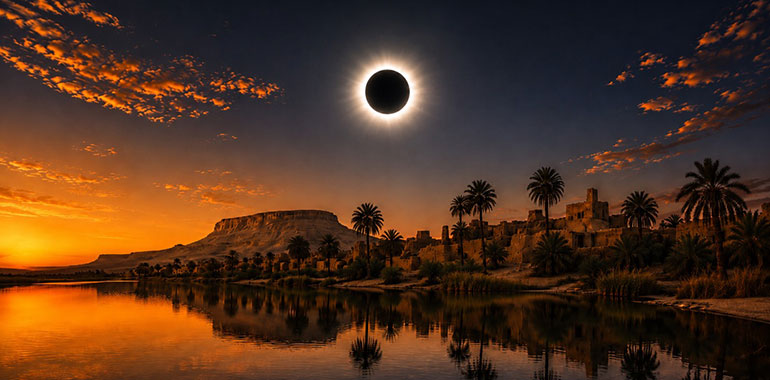
Where Can You See a Solar Eclipse in Egypt?
The most important distinction is between seeing the eclipse and experiencing totality.
On August 2, 2027, many places in Egypt will experience a partial eclipse. But if your goal is to see the Sun completely covered by the Moon, you need to be within the path of totality. Current location calculations identify Luxor, Asyut, and Siwa Oasis among Egyptian locations where totality is visible. Cairo experiences a partial eclipse instead.
| Destination | 2027 Eclipse | Why Consider It? |
| Luxor | Total | Long totality + ancient temples and Nile |
| Siwa Oasis | Total | Desert and oasis setting |
| Asyut | Total | More than six minutes of totality |
| Cairo | Partial | Easy access to Egypt’s capital and major attractions |
| Aswan | Partial | Southern Egypt attractions, but outside the main totality locations |
How Do You Choose the Right Eclipse Location?
Start with one question: Do you want totality or a partial eclipse?
If totality is the priority, choose a location within the eclipse path, such as Luxor, Siwa Oasis, or Asyut.
Then consider the type of Egypt experience you want around the event. Luxor combines the eclipse with ancient Thebes, temples, tombs, and the Nile. Siwa offers a very different experience centered on an oasis and desert environment.
Luxor
Luxor is one of the most compelling choices for travelers who want to combine the eclipse with Egypt’s ancient heritage.
The city is home to major archaeological sites on both sides of the Nile, including Karnak Temple, Luxor Temple, the Valley of the Kings, and the temples of the West Bank.
The 2027 eclipse adds a temporary astronomical event to this permanent historical landscape. Current calculations show about 6 minutes 22 seconds of totality in Luxor, with maximum eclipse occurring at approximately 1:05 p.m. local time.
Because August is extremely hot in Luxor, eclipse-day planning should also account for shade, hydration, transportation, and comfortable viewing conditions.
Siwa Oasis
Siwa offers a completely different setting for totality.
Instead of ancient Theban temples and the Nile, the eclipse can be experienced among oasis landscapes and the Western Desert. Current calculations show approximately 5 minutes 31 seconds of totality in Siwa Oasis, with maximum eclipse around 12:45 p.m. local time.
For travelers who want the eclipse to become part of a desert experience rather than a traditional Nile itinerary, Siwa provides a distinctive alternative.
How Do You Watch a Solar Eclipse Safely?
Solar eclipse viewing requires proper eye protection. Looking directly at the Sun during the partial phases can cause serious eye injury.
Ordinary sunglasses are not sufficient.
Can You Look at a Solar Eclipse With Sunglasses?
No. Regular sunglasses do not provide the level of protection required for direct solar viewing.
Use eclipse glasses or another purpose-built solar viewer that meets the appropriate safety standard. Put them on before looking toward the uneclipsed or partially eclipsed Sun.
What Eclipse Glasses Should You Use?
Use reputable solar viewers designed specifically for direct solar observation. Look for products that comply with the ISO 12312-2 standard.
Inspect eclipse glasses before use. Do not use viewers that are scratched, torn, punctured, or otherwise damaged.
Can You Use Binoculars or a Telescope?
Never look at the Sun through binoculars, a telescope, or another optical device unless it has a properly designed solar filter installed correctly for that equipment.
Concentrated sunlight can cause severe eye damage very quickly.
Is It Safe to Look During Totality?
There is one important exception to the normal rule: during true totality, when the Moon completely covers the bright solar disk, direct viewing of the total eclipse can be possible.
However, eye protection must be put back on before the bright Sun reappears.
Because the transition happens quickly, travelers should follow instructions from qualified eclipse guides and never assume that the Sun is safe to view simply because it has become darker.
What Happens During a Total Solar Eclipse?
A total solar eclipse develops in stages.
At first, the Moon begins covering the Sun while the sky remains relatively bright. As more of the Sun disappears, daylight changes and the surroundings can begin to look unusual.
As totality approaches, the final sliver of sunlight disappears. During totality, the bright solar disk is hidden and the Sun’s outer atmosphere, known as the corona, becomes visible.
The landscape can take on an eerie twilight appearance, temperatures may change, and shadows can behave differently from normal daylight.
Then totality ends. Bright sunlight returns and the eclipse moves back into its partial phase.
The entire eclipse lasts much longer than totality, but totality itself lasts only minutes. That is why location matters so much when planning the trip.
What Should You Bring to Watch a Solar Eclipse?
Eclipse day does not require complicated equipment for most travelers.
A practical packing list includes:
- Certified eclipse glasses
- Water and a reusable bottle
- Hat and sun protection
- Light, breathable clothing
- Sunscreen
- Comfortable shoes
- Phone and power bank
- Camera and spare batteries if photographing
- Proper solar camera filter
- Tripod for photography
- Snacks and any personal essentials
- Your viewing location and transportation details
In Egypt’s August heat, water, shade, and comfortable clothing can be just as important as your eclipse equipment.
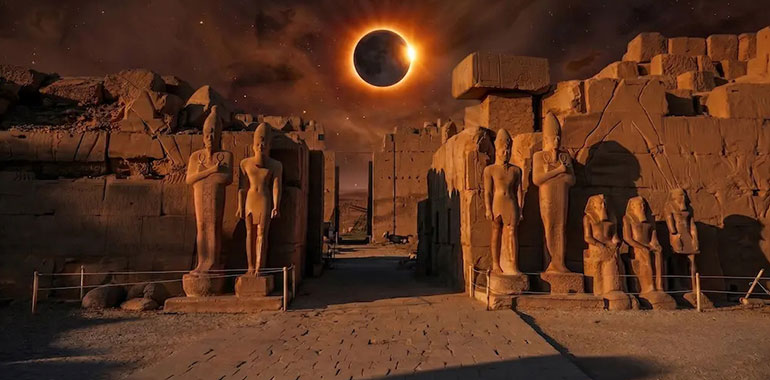
Solar Eclipse Photography in Egypt
Photographing a solar eclipse requires more preparation than simply photographing the landscape.
If you plan to photograph the Sun during the partial phases, your camera and lens need a proper solar filter designed for safe solar photography. Never point an unfiltered telephoto lens or camera directly at the Sun.
A basic setup can include:
- Camera with manual controls
- Telephoto lens
- Solar filter
- Tripod
- Remote shutter or timer
- Spare batteries and memory cards
You can also photograph the wider landscape rather than concentrating only on the Sun. Egypt provides opportunities to combine the changing light with temples, desert landscapes, the Nile, or other recognizable surroundings.
If photography is not your priority, consider spending at least part of totality simply watching. A few minutes can pass surprisingly quickly when you are concentrating on camera settings.
Solar Eclipses and Ancient Egyptian Astronomy
The connection between astronomy and ancient Egypt adds cultural depth to an eclipse journey.
The ancient Egyptians used observations of the sky as part of their systems of calendars and timekeeping. Celestial imagery also appeared in religious and architectural contexts.
One of the most famous examples is the Dendera Zodiac, a celestial representation from the Temple of Hathor at Dendera. It reflects the importance of astronomical imagery in ancient Egyptian culture.
Ancient Egyptian astronomy was not the same as modern astronomy, and there is no need to claim that the Egyptians understood or predicted eclipses according to modern scientific methods.
Instead, an eclipse trip provides an opportunity to explore a broader question: how did people living thousands of years ago understand the sky above them?
That connection makes Egypt especially interesting for travelers who enjoy history, archaeology, astronomy, or cultural experiences.
Experience the 2027 Solar Eclipse in Egypt
The August 2, 2027 eclipse allows travelers to build a complete Egypt journey around a specific astronomical event.
Rather than arranging hotels, transportation, sightseeing, and eclipse-day logistics separately, an organized itinerary can connect the viewing experience with the rest of your trip.
Tripidays has been creating Egypt travel experiences since 1980, with Egyptologist guides, private air-conditioned transportation, planned sightseeing, accommodation arrangements, and 24/7 support.
Depending on your travel style, an eclipse journey can focus on Luxor and the Nile, explore Siwa and the Western Desert, or combine the eclipse with a longer Egypt itinerary.
The eclipse lasts minutes. Your Egypt story can last a lifetime