Marrakech, Morocco, is one of the country’s most distinctive destinations, known for its historic Medina, red-toned architecture, lively souks, grand palaces, and the famous Jemaa el-Fnaa. Set near the foothills of the Atlas Mountains, the city brings together centuries of Moroccan history, traditional craftsmanship, gardens, food, and everyday city life in a compact and atmospheric setting.
Once an important imperial capital, Marrakech remains one of Morocco’s defining cities. Its historic center reveals layers of Almoravid, Almohad, Saadian, and Alaouite heritage, while newer districts show a more modern side of the city. For travelers exploring Morocco, Marrakech can stand on its own or form part of a wider route connecting destinations such as Essaouira, Aït Ben Haddou, the Sahara, Fez, Casablanca, and Rabat.
Marrakech lies in central Morocco, south of the country’s main Atlantic cities and close to the High Atlas Mountains. Its location has helped shape its identity for centuries, linking the city with the mountain regions, southern Morocco, and historic caravan routes.
The city is broadly experienced through two contrasting sides. The Medina, surrounded by historic walls, contains palaces, mosques, souks, riads, workshops, and traditional neighborhoods. Outside the old city, modern Marrakech offers wide avenues, contemporary hotels, restaurants, galleries, and the districts of Gueliz and Hivernage.
This combination gives Marrakech a character that is different from Morocco’s other major cities. It is both a historic imperial city and a modern destination, with its traditional architecture and contemporary life existing side by side.
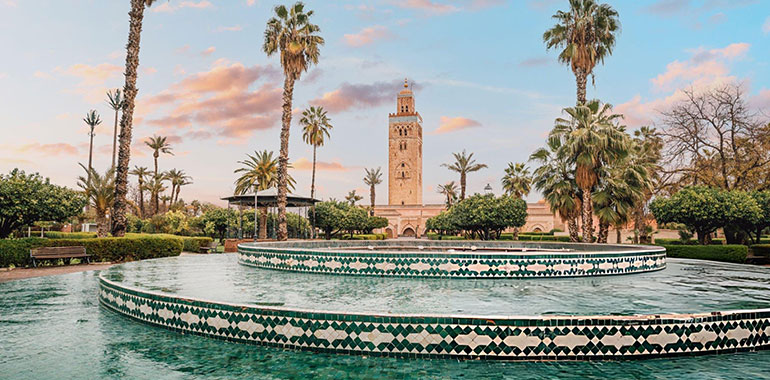
The Marrakech Medina is the historic heart of the city and its most important destination. Recognized as a UNESCO World Heritage Site, the Medina preserves a dense network of narrow streets, traditional houses, historic monuments, markets, and artisan workshops.
Rather than being a single attraction, the Medina is a living part of Marrakech. Its streets lead between major landmarks and quieter residential areas, while small workshops continue traditional crafts such as leatherwork, metalwork, woodwork, ceramics, textiles, and weaving.
The architecture also reflects Marrakech’s history. Decorative plasterwork, carved cedar, colorful tiles, traditional courtyards, and ochre walls are characteristic features of the old city.
At the center of Marrakech’s old city is Jemaa el-Fnaa, the large public square that has become one of the city’s most recognizable symbols.
During the day, the square connects different parts of the Medina and provides a natural starting point for exploring the surrounding souks and streets. As evening approaches, its atmosphere changes as food stalls and performers bring renewed activity to the area.
Jemaa el-Fnaa is particularly important because it represents Marrakech not simply as a collection of historic monuments, but as a city where public spaces, commerce, food, entertainment, and traditions remain part of everyday life.
The Koutoubia Mosque is one of Marrakech’s most recognizable landmarks. Its tall minaret rises above the surrounding Medina and has long served as a visual reference point within the city.
Built during the Almohad period, the mosque reflects the architectural traditions that developed in Marrakech when the city was an important imperial capital. Its minaret is particularly significant in the cityscape, helping define the historic character of Marrakech from viewpoints throughout the surrounding area.
Although the mosque itself is not open to non-Muslim visitors for interior sightseeing, its exterior, minaret, surrounding gardens, and position near Jemaa el-Fnaa make it an important part of any understanding of Marrakech.
Bahia Palace provides another perspective on Marrakech’s architectural heritage. Built in the late nineteenth century, the palace was designed as an elaborate residence with courtyards, gardens, decorated rooms, and intricate architectural details.
Its interiors showcase several elements associated with Moroccan craftsmanship, including zellige tilework, carved wood, painted ceilings, and ornamental plasterwork.
The palace is particularly useful for understanding how elite residential architecture developed in Marrakech and how traditional Moroccan design brought together geometry, craftsmanship, gardens, and private courtyards.
The Saadian Tombs preserve one of Marrakech’s most important surviving connections to the Saadian dynasty, which ruled Morocco during the sixteenth and early seventeenth centuries.
The complex contains elaborately decorated burial chambers and courtyards, with detailed tilework and carved architectural elements. Its discovery and preservation have made it an important historical site within the southern Medina.
Together with the Koutoubia Mosque and Bahia Palace, the tombs help reveal the different periods that shaped Marrakech and its role as an imperial city.
Away from the historic core, the Majorelle Garden offers a very different experience of Marrakech. Created by French artist Jacques Majorelle and later associated with Yves Saint Laurent and Pierre Bergé, the garden is known for its botanical collections, colorful architecture, and distinctive visual style.
Its plants, pools, pathways, and buildings create a calmer environment compared with the busy streets of the Medina.
The garden also illustrates another layer of Marrakech’s modern cultural history, showing how the city has attracted artists, designers, and travelers from around the world while maintaining its Moroccan identity.
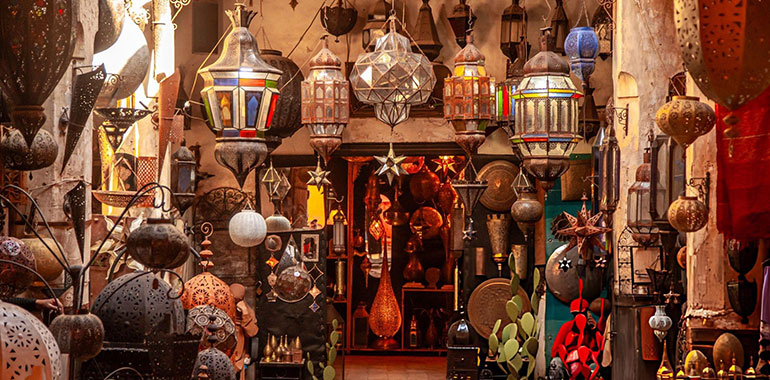
The souks of Marrakech extend through much of the Medina and form one of the clearest expressions of the city’s traditional commercial culture.
Different areas are associated with different crafts and products, including leather, lamps, carpets, textiles, metalwork, woodwork, ceramics, and spices. The experience is less about visiting a single market and more about moving through a network of workshops and small shops connected by narrow streets.
For visitors, the souks also provide an opportunity to see traditional Moroccan craftsmanship in context rather than only as finished souvenirs.
Marrakech’s identity is strongly connected to its architecture. The city’s traditional buildings often use local materials and earth-toned colors, giving the Medina its characteristic red and ochre appearance.
Inside many historic buildings, the exterior simplicity gives way to detailed courtyards decorated with zellige, carved wood, painted ceilings, and ornamental plasterwork. Riads are a particularly distinctive example, organized around an internal courtyard that creates privacy and brings light into the center of the house.
Food is another important part of Marrakech’s cultural identity. Traditional Moroccan dishes such as tagines, couscous, pastilla, and harira can be found alongside bakeries, market stalls, restaurants, and modern dining spaces.
For travelers planning their first visit, the wider cultural context can be useful before choosing where Marrakech fits into a Morocco itinerary. Tripidays’ Morocco travel resources for first-time visitors can provide additional context on the country’s destinations, customs, and travel experience.
The Atlas Mountains form an important geographical backdrop to Marrakech. On clear days, the High Atlas can be seen from parts of the city, creating a striking contrast between the urban landscape and the mountains beyond.
This proximity makes Marrakech a natural base for exploring mountain landscapes and Berber communities in the surrounding region. The relationship between the city and the mountains also helps explain Marrakech’s historic importance as a meeting point between northern Morocco, the Atlas region, and the routes leading farther south.
The mountains are therefore more than a scenic backdrop. They are part of the geographical setting that has shaped Marrakech’s role in Morocco.
Marrakech can also be paired naturally with Morocco’s Atlantic coast. Essaouira, known for its fortified Medina, harbor, beaches, seafood, and relaxed coastal atmosphere, provides a strong contrast to Marrakech’s inland setting.
The two destinations are frequently combined because they offer very different experiences within the same journey: Marrakech represents Morocco’s historic inland imperial culture, while Essaouira introduces the country’s Atlantic character.
This makes the Marrakech–Essaouira connection particularly useful when planning a broader Morocco itinerary rather than treating each city as an isolated destination.
Marrakech is also an important starting point for routes toward southern Morocco.
Journeys from Marrakech can continue through the High Atlas toward destinations such as Aït Ben Haddou and Ouarzazate before reaching the desert regions farther east. These routes connect the city with some of Morocco’s most dramatic landscapes, from mountain passes and valleys to fortified villages and Sahara scenery.
For travelers interested in seeing several sides of Morocco, Marrakech therefore works as both a destination and a gateway to the country’s southern regions.
Marrakech can fit into Morocco itineraries in several ways depending on the destinations included and the overall length of the journey.
A shorter Moroccan journey might focus on Marrakech alongside Casablanca and Rabat. A longer route can connect Marrakech with Fez, Chefchaouen, the Sahara, or the Atlantic coast. Marrakech is also frequently used as a southern or central point in journeys that continue toward Aït Ben Haddou, Ouarzazate, and desert destinations.
Its importance comes from this flexibility. Marrakech is not simply a city to visit for a collection of monuments; it can act as a central destination around which a wider Moroccan journey is built.
For travelers who want to combine Morocco with the ancient sites and Nile Valley of Egypt, Egypt and Morocco tour packages offer another way to experience Marrakech within a two-country journey. This approach can bring together Marrakech’s Medina and imperial heritage with destinations such as Cairo, Giza, Luxor, and the Nile.
Tripidays includes Marrakech in selected Morocco and Egypt–Morocco itineraries, allowing travelers to experience the city as part of a carefully organized journey rather than arranging every destination separately.
Depending on the itinerary, Marrakech can be combined with Morocco’s historic cities, desert regions, or major Egyptian destinations. This makes the city particularly relevant for travelers looking for a broader cultural journey rather than a standalone Marrakech visit.
Tripidays’ experience in organizing Egypt and Morocco journeys also allows Marrakech to be placed within a route where transfers, sightseeing, accommodation, and connections between major destinations are planned together.
Marrakech is one of the country’s essential destinations, but it is only one part of Morocco’s diverse landscape. Travelers can discover the country’s imperial cities, Atlantic coast, northern mountains, and Sahara through our Morocco top destinations, including Fez, Casablanca, Chefchaouen, Rabat, Essaouira, Tangier, and Merzouga.
Its imperial past, Medina, souks, architecture, gardens, craftsmanship, food, and relationship with the Atlas Mountains create a destination that is both historically significant and culturally active. The city also provides a natural connection between northern Morocco, the Atlantic coast, and the southern routes leading toward the Sahara.
For travelers discovering Morocco for the first time, Marrakech offers an immediate introduction to many of the country’s defining characteristics while still having a distinct identity of its own.
Marrakech connects naturally with several other destinations across Morocco:
Together, these destinations show why Marrakech is best understood as part of Morocco’s wider geographic and cultural network rather than as an isolated city.
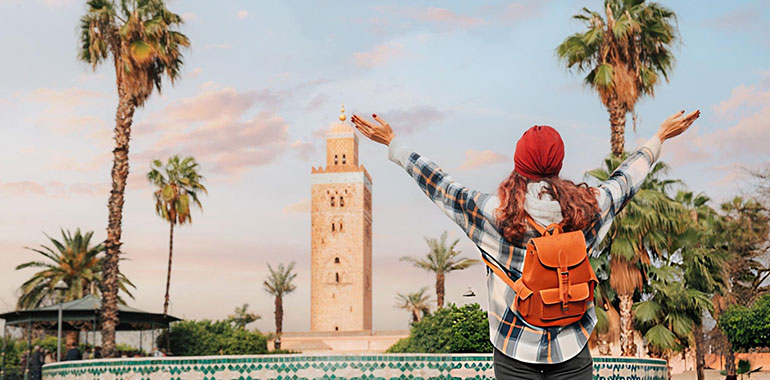
Whether Marrakech is the main focus of your Morocco journey or one stop within a larger route, the city offers an unusually rich combination of history, architecture, traditional culture, food, craftsmanship, and surrounding landscapes.
From the streets of the Medina and Jemaa el-Fnaa to the Koutoubia Mosque, historic palaces, gardens, and routes toward the Atlas Mountains and Sahara, Marrakech provides a strong introduction to Morocco.
For travelers combining the country with Egypt, Marrakech can also become part of a broader two-country experience, connecting Morocco’s imperial heritage with Egypt’s ancient monuments and Nile Valley.


Tripidays Egypt Tours has been offering an exceptional range of Egypt tours, vacation packages, Nile cruises, day trips, and shore excursions tailored to meet the diverse interests of travelers worldwide for over 45 years.